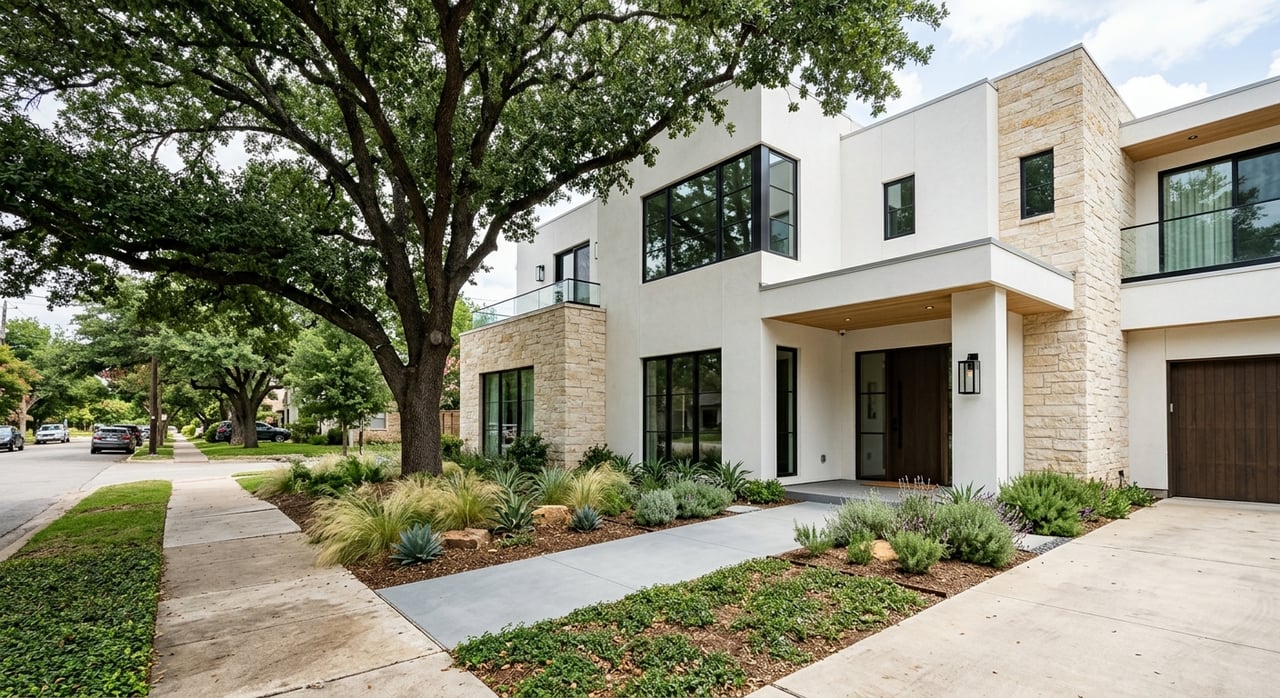
Central Austin Or The Suburbs? How To Decide Where To Live
June 11, 2026
June 11, 2026
If you are torn between Central Austin and the suburbs, you are really deciding how you want your days to feel. For some buyers, being close to parks, restaurants, and the urban core is worth a smaller lot or a higher price point. For others, more space and a lower home value matter more than shaving minutes off a commute. This guide will help you weigh the tradeoffs so you can choose the Austin lifestyle that fits you best. Let’s dive in.
The biggest difference between Central Austin and the suburbs often shows up in your everyday schedule. If you want easier access to errands, coffee shops, dining, and city amenities, central neighborhoods tend to offer more convenience without getting in the car for every stop.
That shows up clearly in walkability data. Austin’s citywide Walk Score is 42, but several central neighborhoods score much higher, including Hancock at 79, Hyde Park at 78, and Zilker at 75. By comparison, suburban cities like Round Rock and Cedar Park both score 26, Leander scores 28, Pflugerville scores 23, and Kyle scores 17.
Walk Score is useful because it measures how close amenities are and how easily you can reach them through the street network. In plain terms, it gives you a practical way to compare how car-dependent one area may feel versus another.
If your job, meetings, or regular activities happen near downtown or in the urban core, Central Austin can save you meaningful time. The mean commute in the central Austin PUMA is 20.6 minutes, compared with 24.2 minutes citywide and 28.2 minutes across the metro.
That does not mean central living is automatically better for every buyer. If you already work in a suburban job center, the time advantage may narrow. Your best choice depends on where you go most often, not just where the map says the center of the city is.
Central Austin also stands out for transportation options beyond driving. Hyde Park has a transit score of 56 and bike score of 94, Hancock has a transit score of 60 and bike score of 90, and Zilker has a transit score of 47 and bike score of 82.
If you want the ability to bike to nearby spots, use transit more often, or simply have more choices in how you move through the city, that can be a major quality-of-life benefit. In most suburban areas, daily life tends to stay much more car-first.
Your housing preferences matter just as much as your commute. Central Austin tends to offer older, more varied housing stock, while suburban areas more often deliver newer-feeling neighborhoods and a more uniform housing pattern.
Austin’s consolidated housing plan shows that 37% of owner-occupied units and 30% of renter-occupied units were built before 1980. At the same time, most of the city’s overall housing stock was built after 1980, which helps explain why Central Austin can feel architecturally different from many outlying areas.
A North Central Austin historic survey describes older apartment houses, boarding houses, small single-family homes, and bungalow-era development near the university and downtown. That mix is part of what gives close-in neighborhoods a layered, established feel.
In practical terms, central neighborhoods usually feel older, denser, and more mixed in housing style. Austin’s planning materials note that the city’s residential pattern still leans heavily toward single-family homes and large apartment complexes, with relatively little missing-middle housing added since 1984.
That means your options in Central Austin may include classic bungalows, condo-regime homes, apartments, and infill properties in the same general area. If you value variety, design character, and close-in location, that mix can be appealing.
Suburban living often flips the equation. You may get more space, easier parking, and a more car-oriented routine in exchange for longer drives and lower walkability.
For many buyers, this is the core tradeoff. Central Austin often asks you to give up some yard space and convenience around parking in return for proximity and access. The suburbs usually offer the reverse.
Price matters, but it helps to think about price as part of a bigger decision about time, access, and housing type. In directional terms, the central Austin PUMA has a median owner-occupied value of $895,900, compared with $555,300 citywide.
Nearby suburbs come in lower. Cedar Park is $513,600, Leander is $506,200, Round Rock is $418,600, Pflugerville is $402,400, and Kyle is $334,600.
These figures come from different ACS datasets, so they are best used as a directional comparison rather than an exact side-by-side. Still, the pattern is clear: close-in Austin usually commands a premium.
In many cases, buyers in Central Austin are paying for location efficiency. You are often buying faster access to the city core, stronger walkability, more transportation options, and immediate connection to parks, dining, and cultural amenities.
Austin’s Strategic Housing Blueprint also notes that home prices have increased 58% since the original mid-2010s goals were set, while rents remain high. That affordability pressure is part of the backdrop for any decision between central neighborhoods and suburban alternatives.
Where you live affects more than your commute and budget. It also shapes how easily you can enjoy Austin’s outdoor spaces, cultural offerings, and everyday hangouts.
Central Austin has a strong concentration of major parks and public amenities. The Ann and Roy Butler Hike-and-Bike Trail is a 10-mile loop in the heart of the city, draws more than 2.6 million visits a year, and also functions as an alternative transportation route for the urban core.
Barton Creek Greenbelt adds more than 12 miles of trails, swimming holes, and bike terrain. Zilker Park spans more than 350 acres and includes Barton Springs Pool, the botanical garden, the nature center, and the Butler Trail.
If being close to restaurants, coffee shops, and city energy matters to you, some central neighborhoods deliver that in a big way. Walk Score reports about 53 restaurants, bars, and coffee shops in Hyde Park, about 52 in Hancock, and about 102 in Zilker.
Austin’s cultural-arts and live-music offices also reinforce the city core’s role in supporting creative spaces and live music venues. That helps explain why many buyers see Central Austin as a lifestyle choice as much as a housing choice.
Austin’s preservation materials add more context. Areas with majority pre-1945 buildings make up less than 4% of the city’s land area, yet they contain 20% of the city’s arts and cultural facilities. That concentration adds to the character and amenity density many buyers are looking for in close-in neighborhoods.
Data can also help you understand who tends to live where, even though every buyer’s priorities are personal. The central Austin PUMA has a median age of 31.8 and an average of 1.8 persons per household.
By comparison, Cedar Park has a median age of 39.6 and 2.7 persons per household. Round Rock averages 2.6 persons per household, and Pflugerville averages 2.7.
This does not mean one option is better than the other. It simply suggests that central living often aligns with smaller households and a more location-first approach, while suburban areas may align more often with buyers looking for more space and a different daily rhythm.
One of the biggest mistakes buyers make is treating Central Austin as a single market. It is not. Hyde Park, Hancock, and Zilker are strong examples of walkability, but the citywide Walk Score is much lower, which shows how much neighborhood-level differences matter.
That is why a smart search goes beyond broad labels like “central” or “suburban.” You want to compare specific neighborhoods, specific blocks, and specific housing types against the way you actually live.
For example, one buyer may prefer a design-forward infill home close to restaurants and trails. Another may decide that extra square footage and a lower entry point are more important. Both choices can be right if they match your priorities.
If you are still unsure, ask yourself two questions. How much are you willing to pay for time and access, and how much space do you want in return?
Choose Central Austin if your top priorities are walkability, shorter commutes to the core, bikeability, older character, and immediate access to parks, dining, and culture. Choose the suburbs if your priorities lean more toward lower owner-occupied home values, more space, and a car-first routine.
The right answer is usually not about what is objectively best. It is about which tradeoffs make your life easier, more enjoyable, and more aligned with your goals.
If you want help comparing close-in neighborhoods, evaluating design-forward homes, or weighing central Austin against suburban options with a clear strategy, Darsh Parikh can help you make a smart move with confidence.
Stay up to date on the latest real estate trends.
From Rooftop Patios to Sculpture Trails Around Rollingwood.
Beyond the broad appeal of a Westlake address, maximizing your home's sale depends on attracting the right buyer.
Explore the appeal of Tarrytown and what to consider before buying a home in one of Austin's best neighborhoods.
A Guide to Selling Your Multimillion-Dollar Austin Home.
Exploring Austin's majestic Barton Hills community, among the city's most sought-after residential destinations.
Work with a top real estate expert in Austin. Buying or selling a home, they can help you. Contact them now to start your home-searching journey!