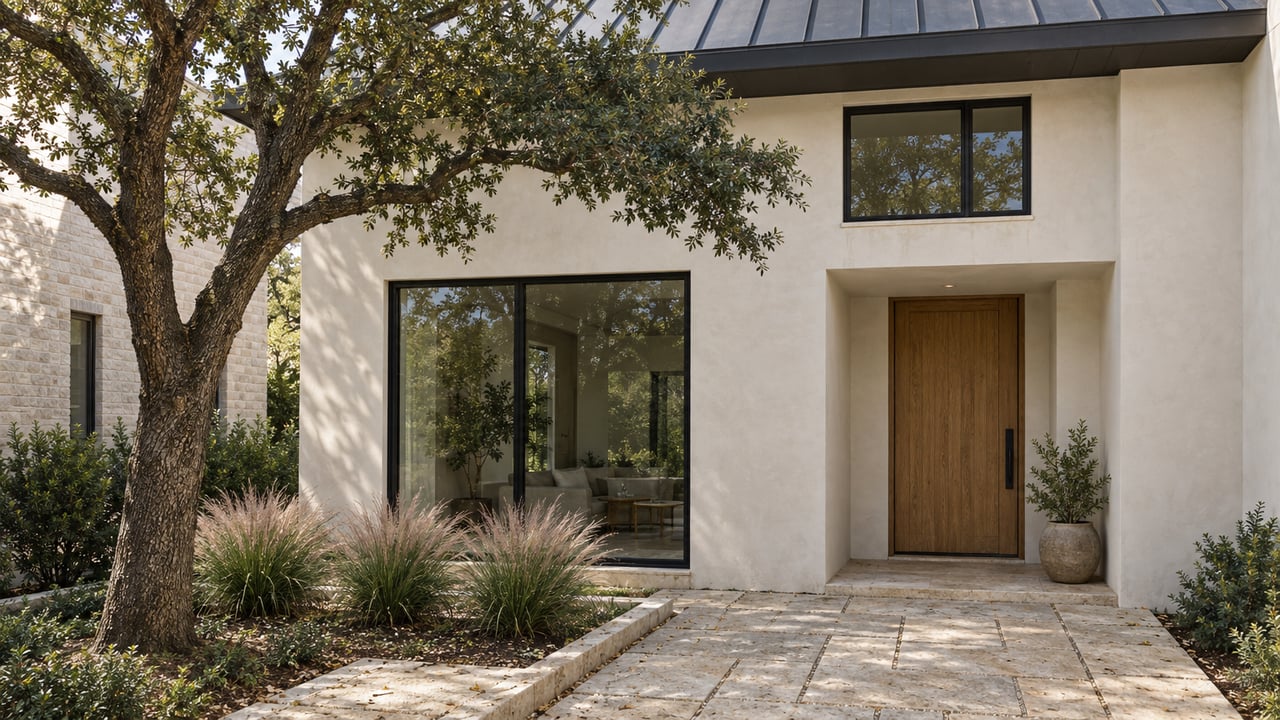
How HOME Rules Shape East Austin Lot Splits
October 1, 2026
October 1, 2026
Most explanations for East Austin's building boom start with demand: young buyers, restaurant density, proximity to downtown. That story isn't wrong, but it skips the mechanism that actually decides which lots get split into two or three units and which don't. The deciding factor isn't how much a buyer wants to live there. It's whether the neighborhood had a protective zoning overlay in place before the city's HOME initiative took effect. East Austin, more than almost any other close-in Austin neighborhood, didn't.
That gap is now showing up in listing photos, city council agendas, and appraisal spreads wide enough to change how a buyer or small developer should read a lot before making an offer.
Search active land listings in 78702 or 78721 right now and you'll find parcels marketed with build-out options already attached. One recent 78702 listing offers a buyer a choice: build three units at roughly 1,950 square feet each, or two units closer to 2,480 square feet, with permitted plans that convey with the sale. The existing structure, a 1940s bungalow, is described as a likely teardown. Listings like this aren't unusual in East Austin in 2026. They're becoming the default way land is marketed in the neighborhood's core zip codes.
This is downstream of a specific policy. Austin's HOME initiative, adopted by city council in two phases starting in December 2023 and taking effect citywide by November 2024, allows up to three housing units by right on most single-family zoned lots, according to the city's own development services page. Phase 2 also cut minimum lot sizes, which is what makes a single East Austin parcel pencil out as two or three saleable lots instead of one.
The policy applies citywide. The building doesn't happen evenly.
The Austin Board of Realtors tracked HOME-built units sold in 2025 and found a median sales price of $750,000 across 57 units, compared with a $1.58 million median for 115 traditional single-family homes sold in the same period, according to reporting from Community Impact. That's not a modest discount. It's roughly half.
A $750,000 median doesn't mean HOME units are cheap in any absolute sense, and city residents quoted in the same coverage pointed out that the price still sits well above what a teacher or a first responder could afford. But for the buyer comparing East Austin to Tarrytown or Old West Austin, the number explains something the median sale price alone never will: East Austin's blended pricing looks lower partly because a growing share of its inventory is smaller, multi-unit product built specifically to hit a lower price band, not because the land underneath it is worth less.
The reason East Austin absorbed this shift while other close-in neighborhoods didn't comes down to a layer of zoning history that predates HOME by decades.
| Neighborhood | Protective overlay before HOME | Practical effect today |
|---|---|---|
| East Austin (78702, 78721, 78722, 78723) | Austin City Council records identify the East 11th and 12th Street NCCD | HOME applies by right on most lots; three-unit builds are common |
| Old West Austin (Clarksville) | National Register Historic District with local historic district review | Austin's Land Development Code requires a Certificate of Appropriateness before altering or replacing a contributing structure, which slows or blocks the kind of teardown-and-split that's routine in East Austin |
| North University, near the UT campus | Neighborhood Conservation Combining District (NCCD) | According to Community Impact, HOME does not currently apply here; the NCCD already shaped smaller-scale housing under its own rules |
Neighborhoods with a National Register Historic District or an NCCD had local rules of their own. East Austin, largely built out before Austin's modern historic-district and NCCD process existed in its current form, had a different zoning history when the citywide policy landed.
That line is not fixed. In May 2026, Hoodline reported that Austin City Council voted 9-1 on a resolution authored by Council Member Krista Laine, directing city staff to draft amendments that would study extending HOME's reach into neighborhoods currently exempted by NCCDs and regulating plans, as well as the Lake Austin overlay that currently restricts development near the waterway. Austin Planning spokesperson Caleb Pritchard said plainly that the change is likely to expand where HOME applies.
The resolution's language was framed as exploratory rather than automatic. According to OWANA, Council staffer Isabel Webb Carey said there's nothing in the text that would let HOME override an NCCD outright, and Laine's office said any real change would still require a full public process before returning to council as an ordinance. But residents in protected neighborhoods read the direction of travel differently.
North University resident Peter Journeay-Kaler told OWANA: "This already, to me, feels like something that hasn't gotten the public input that's needed for people to say how they feel about it."
His neighborhood sits inside an NCCD that has kept it out of HOME's reach so far. His neighbor Pam Bell, who has lived there since the 1970s, said she'd seen no outreach about the proposal at all.
For East Austin, the practical read is this: the neighborhood's current status as the easiest place in Austin's urban core to split a lot isn't a permanent structural advantage. It's a byproduct of an accident of zoning history that the city is now actively studying how to close. If NCCDs elsewhere lose their exemption, the supply of easy infill lots stops concentrating so heavily in 78702 and 78721, and whatever pricing edge East Austin's split-lot product currently holds gets diluted by new competition from neighborhoods that were previously off limits.
For a buyer evaluating a standard single-family home in East Austin, the question worth asking before comparing it to a similar listing in an older, protected neighborhood isn't just square footage or finish level. It's whether the price reflects a traditional home or a HOME-era build, and whether the lot next door is likely to become three units before you've finished unpacking.
For a seller holding a larger lot in 78702, 78721, 78722, or 78723, the HOME-versus-traditional price gap is a pricing signal, not just a policy footnote. A property's value increasingly depends on whether it's marketed as a home to live in or as a development site with build-out options attached, and those two framings can produce very different offers for the same physical parcel.
For a small developer or investor weighing East Austin against a neighborhood the city hasn't touched yet, the May 2026 resolution is the detail worth tracking over the next year. If the exemption that's kept NCCDs and the Lake Austin overlay out of HOME's reach narrows, the calculus around scarcity in East Austin's infill product changes with it.
Does every East Austin lot qualify for a two or three-unit split? Not automatically. Impervious cover limits, utility capacity, existing structure size, and heritage tree protections still apply, and a lot with an existing house that already covers most of the allowable footprint may not have practical room for additional units even where zoning technically permits it.
Is the May 2026 resolution already law? No. It directs city staff to draft potential code amendments for future council consideration. Any actual expansion of HOME into NCCDs or the Lake Austin overlay would still require a separate ordinance and public process.
Does a HOME-eligible lot always mean lower resale value? Not necessarily. The $750,000 median for HOME units reflects smaller unit size and product type, not a judgment on land value. A well-positioned East Austin lot can support either a single larger home or a multi-unit build, and the right call depends on what the surrounding block is actually doing, not on the zoning code alone.
If you're weighing a lot in East Austin against one in a more heavily protected part of the city, the zoning history behind each address matters as much as the price per square foot. Darsh Parikh and the team at Darsh Advisory Group work through exactly this kind of comparison with buyers, sellers, and developers across Austin's urban core, and can walk you through what a specific parcel's entitlements actually allow before you make an offer.
This article is general information, not legal, tax or financial advice. Consult a qualified professional about your situation.
Stay up to date on the latest real estate trends.

Designing a Luxury Home Office That Fits Austin Real Estate.
From Rooftop Patios to Sculpture Trails Around Rollingwood.
Beyond the broad appeal of a Westlake address, maximizing your home's sale depends on attracting the right buyer.
Explore the appeal of Tarrytown and what to consider before buying a home in one of Austin's best neighborhoods.
A Guide to Selling Your Multimillion-Dollar Austin Home.
Work with a top real estate expert in Austin. Buying or selling a home, they can help you. Contact them now to start your home-searching journey!